
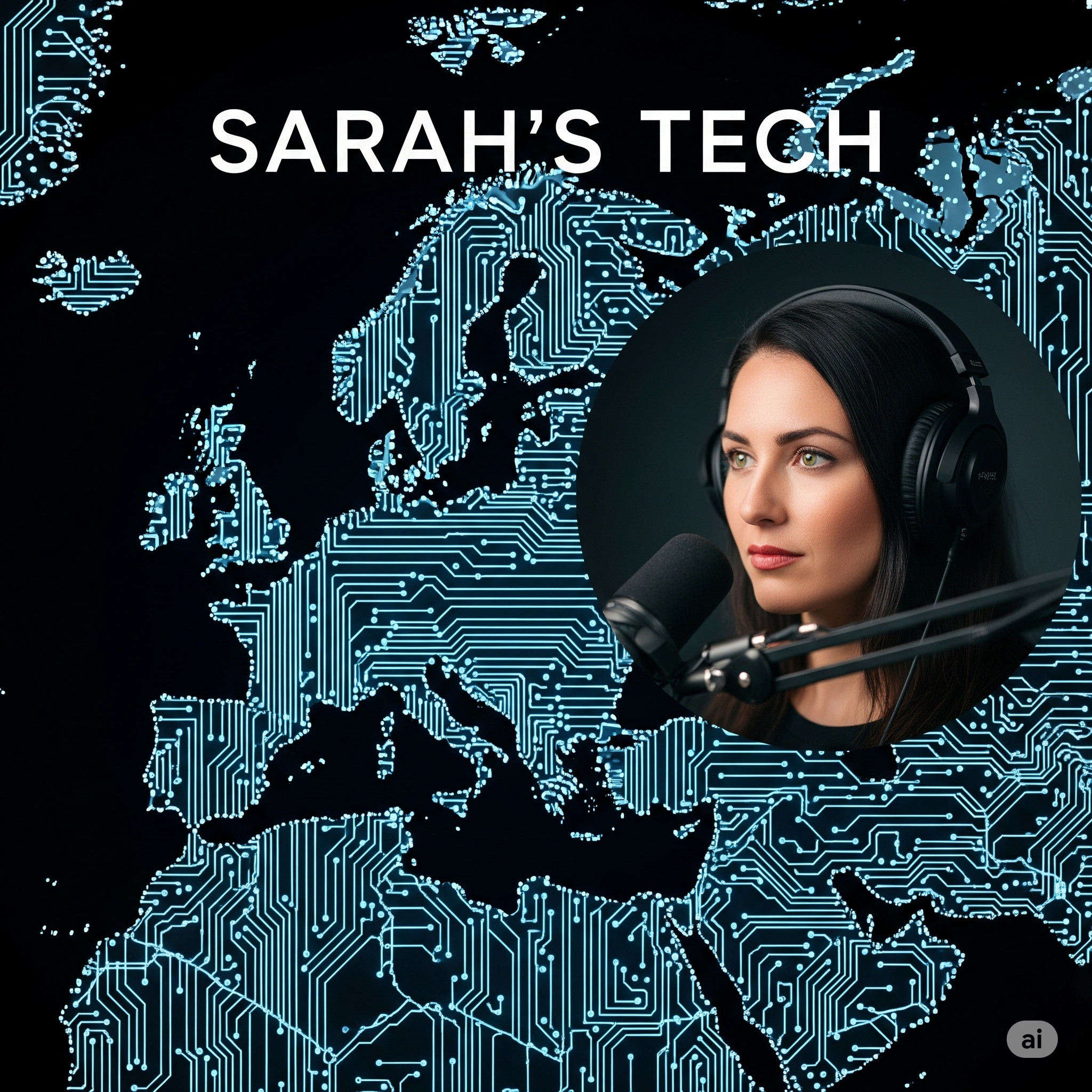
The sound that started Season 1, Episode 5 of Sarahs Tech was a heavy coffee mug slamming onto the table. It was the sound of my co-host, Sarah, running on three hours of sleep and absolute fury. Why?
Over the weekend, Washington drew a digital line in the sand. Anthropic pulled its top-tier Claude models offline globally. Why? Sudden US Department of Commerce export controls. Software treated like military hardware. The lockout was so strict it even affected Anthropic’s own European developers. Europeans are, once again, looking into an empty tube.
Sarah called it digital segregation. I call it architectural inevitable.
This episode was supposed to be a deep dive into the reports of Enrico Letta and Mario Draghi on European competitiveness. But the Anthropic shock proved the exact point I keep making: relying on centralized American monoliths is a high-risk strategy.
Digital Fiefdoms and Renters
We had an intense debate about why Europe regulators build beautifully formatted, GDPR-compliant cookie banners while Seattle-based hyperscalers manage 90% of all European corporate data. Sarah argues we are just a „digital colony“—renters in a house owned by Seattle.
We analyzed the regional contradictions:
- The Nordic Mirage: Scandinavia is a tech paradise for user adoption (BankID, MitID), but architecturally, they national national islands that have handed the keys of the kingdom to AWS and Azure.
- The French Compromise: Mistral AI preaches European independence, then immediately signs a partnership with Microsoft.
- The Italian Guillotine: The data protection authority blocks everything first, prioritizing dignity over Roman jobs.
- The Spanish Socket: Spain builds the physical data centers, Strain Strain its regional grid and water supplies, while profits and algorithmic intelligence fly back to California.
The Fragmentation of the US Monolith
While I understand Sarah’s frustration with European hesitation, she often praises the US as this perfect, frictionless monolith where scaling is easy.
That is a myth. In mid-2026, the US market is fracturing at a terrifying pace.
Culturally, localization is now essential (the massive economic superpower of the Hispanic population means you need Spanish-First deep local marketing). But more importantly, it is fracturing legally. Washington has completely failed to pass a federal privacy law. US states have taken over.
For a modern tech startup in the US, compliance is now a legal minefield spanning Arkansas, California (with its new Delete Act), Indiana, Kentucky, and Rhode Island. They are experiencing exactly the kind of Zersplitterung Sarah blames Europe for.
The Blueprint for Sanity: Federated Hybrid Strategy
It was here, looking at the Netherlands-based powerhouse Nebius Group, that we found our middle ground.
Nebius is building the heavy AI factories Europe needs, but they are architecturally locked into NVIDIA’s proprietary software trap. They are becoming high-end data foundries and power-grid providers for American models. As I told Sarah, they supply the electricity; California harvests the intelligence.
The corporate cloud silo is breaking down under its own legal and physical weight.
We cannot wait for permission. We must utilize global efficiency without surrendering local sovereignty. The future is not monolithic.
Our compromise is the Federated Hybrid Strategy. We use the global hardware networks—for compute power and raw engineering speed (shout-out to site.pro in Lithuania for pragmatic, Baltic code). But we keep our data governance and our execution layers completely local. We run local stacks (Ollama, Jan.ai) right on our desks. We build a network of sovereign, highly automated nodes that talk across borders without ever surrendering their core data.
We out-engineer the monopolies at a human scale.
Listen to the full debate and find the economic reports (Letta, Draghi) in our show notes on Substack. If you are a Baltic dev or part of the „clean code“ movement in Eastern Europe, I’d love to hear your take on the Federated architecture in the comments.

Kommentar verfassen