markus.technology

Sarah's Tech: Tech-Podcast über europäische Tech-Branche, KI & Startups

Startseite » Podcast » The Strategy Illusion

The Strategy Illusion

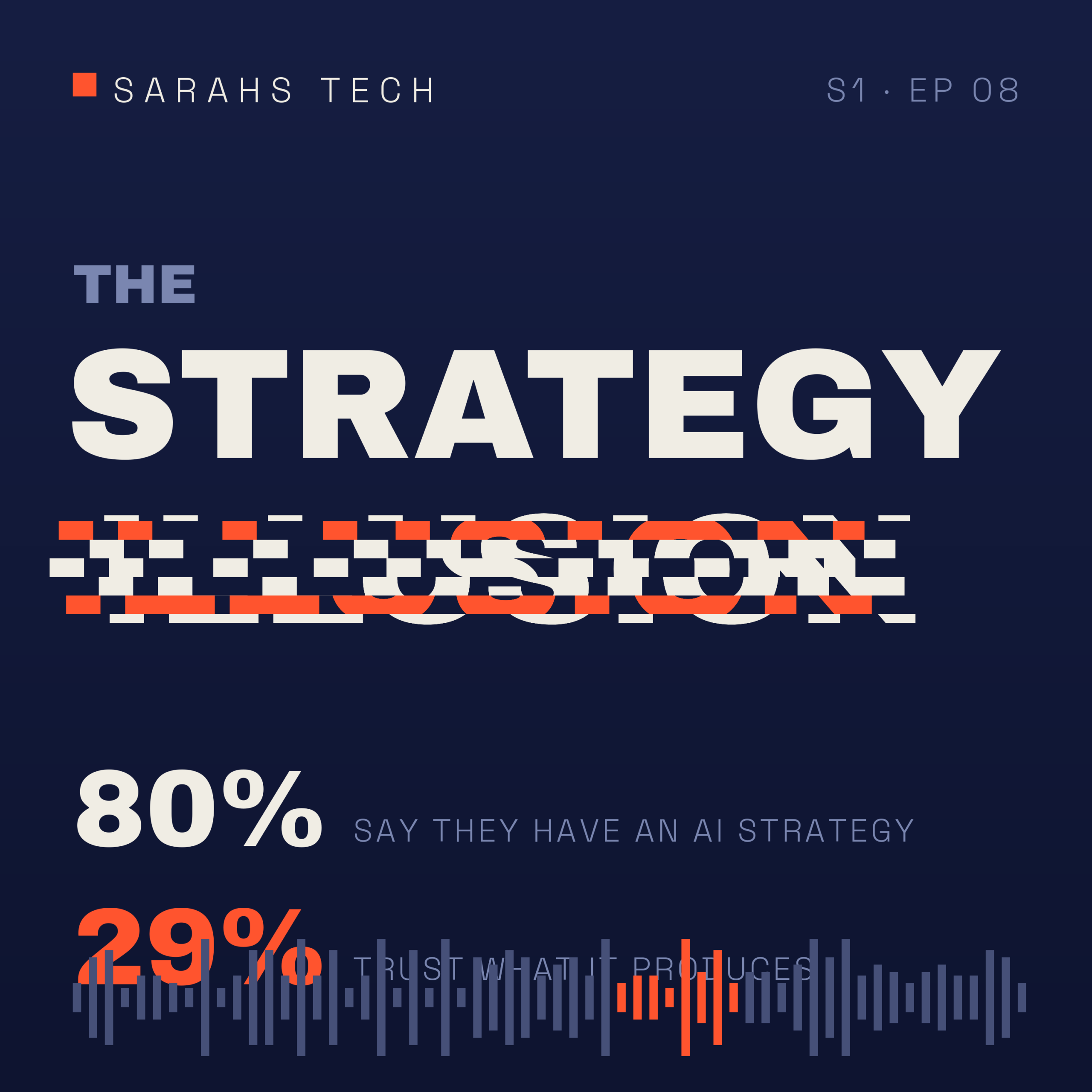
Sarahs Tech Podcast Cover 08 Season 1 2026 Strategy Illusion Sarahs Tech — a show hosted by someone who doesn't exist, with facts that very much do.

Verfasst von

in

What Bosses Believe, What Builders Know (Sarah’s Tech S1·E08)

80% of European industrial companies say they have an AI strategy. The developers who build the actual products trust AI output at 29%. Someone here is wrong — or, more uncomfortably, nobody is.

The new episode of Sarahs Tech is out, and it lives in the gap between those two numbers.

What this episode is about

We start with a bet. Before the jingle, Markus claims AI makes him about twenty percent faster. Would he put money on that? He shouldn’t. A research lab recently put a stopwatch on experienced developers working on real tasks — randomized, screens recorded, time measured. With AI, they were 19% slower. And afterwards, they estimated they had been 20% faster. That forty-point gap between feeling and reality is the theme of the whole episode.

From there, we take the elevator through European tech, floor by floor:

The status report from the wall. The EU AI Act’s transparency rules go live on August 2nd — and no, the „delay“ you read about doesn’t apply to you. The high-risk rules were pushed to 2027 and 2028; the labeling duties arrive on time. There are official EU icons now („AI GENERATED“ / „AI MODIFIED“), the label belongs inside the content rather than the caption, and unlike NIS2, anyone with a smartphone can spot a violation. We walk through what that means for marketing teams, agencies, publishers and podcasters — including one detail that surprised us: AI translation counts as content that needs marking.

The view from the top floor. A fresh survey asked 800 industrial decision-makers across eight European countries about digital strategy. The results look great. Suspiciously great: 88% have a digitalization strategy, 80% an AI strategy, 92% plan new digital business models within three years. We do the source criticism this study deserves — and then dig out the three findings that are genuinely revealing. Data sovereignty ranks only third among infrastructure priorities, behind security and cost. Only half of decision-makers see Europe as one unified market — and the country that believes in it most is Germany, while France believes in it least. Germany dreams the European dream. Alone.

The view from the workbench. The people actually building the products tell a different story. Developer adoption of AI tools is basically done (84%), but trust in the output collapsed to 29% — and the most experienced developers are the most skeptical. Two thirds name the same frustration: solutions that are almost right, but not quite. Meanwhile, DACH freelancers have quietly turned pragmatic: more than half use AI daily, 18% already report lower hourly rates because of it, and 44% don’t tell their clients at all. That silence gets expensive after August 2nd.

We close with a practical four-step checklist to get ready for the deadline — inventory, review workflow, labels, contracts — plus one piece of advice for freelancers that has survived every technology Markus has worked with since 2000: say it before they ask.

One more thing

We open this episode with a confession. Sarah — the host this show is named after — doesn’t exist. Her voice is synthetic, her personality is a writing device, and everything she says is researched, written and editorially owned by Markus. From August 2nd, that disclosure becomes a legal requirement. We’re just early. Full concept behind Sarah: markus.technology/sarah

Listen now

🎧 Listen to the episode on your favorite podcast app or directly here:
A Ritual Without a Religion | How Europe Almost Killed the Cookie Banner — and Who Saved It Sarah's Tech

Episode 13: A Ritual Without a Religion | How Europe Almost Killed the Cookie Banner — and Who Saved It Brussels proposed the one piece of deregulation everybody claims to want: set your tracking preference once, and never see a cookie banner again. Then Germany, France, Poland and Google teamed up to save the banner. Underneath the absurdity: does advertising actually need tracking? Two hosts, two sets of numbers, one honest fight — and neither of them wins it cleanly. In this episode: 00:00–02:42: Cold Open & The Sound of the Web. How many cookie banners did you click away today? Nobody knows — and that isn't a failure of memory, that's the design. Then the ritual itself: the wall before the article, 847 partners who value your privacy, the big friendly Accept button, the Reject button that is sometimes there and sometimes buried under forty toggles and a separate set of legitimate interest switches. The most visible piece of European tech regulation ever built, billions of clicks per day. And the setup for the whole episode: this year, Europe almost killed it — and then Germany, France and Google saved it. 02:42–08:17: What Almost Happened. The Digital Omnibus explained fast: one law amending many, most of it written for compliance departments. Buried inside it, one article written for users. Article 88b would have made a machine-readable privacy signal legally binding — set once in your browser, operating system or a consent agent, and websites must respect it, with a carve-out for journalistic media. The idea is fifteen years old: Do Not Track existed, was voluntary, and was ignored until the standards body gave up in 2019. Then the deletion: a leaked Council document shows the Cypriot presidency's compromise striking 88b entirely. Germany, France and Poland pushed for it, citing possible harm to the European economy and a missing impact assessment — an objection raised for the one article that helps users and for none of the twenty that help the ad industry. Google's paper "Gone in one click" puts the damage at forty to fifty billion euros; German industry associations and, awkwardly, the press publishers line up behind it. Plus Germany's own consent management regulation, which was defanged at the last minute and produced exactly one certified service. 08:17–15:00: The Actual Fight — Does Advertising Need Tracking? Markus makes the case for contextual advertising: a hundred years of ads sold against context, the washing machine that follows you for three weeks after you bought it, and the Dutch broadcaster NPO, whose sales house Ster switched off third-party tracking in January 2020 and saw revenue rise sharply year over year — with ninety percent of visitors opting out when saying no was made easy. Add the research finding that behavioural targeting earns the publisher only around four percent more, and the conclusion writes itself: tracking isn't necessary for advertising, it's necessary for the intermediary chain. Then Sarah takes it apart, point by point. The NPO analysis was written by Brave's chief policy officer, and year-over-year is not a controlled experiment. NPO sells context because NPO has context — the niche forum and the recipe blog don't, so killing tracking may redistribute from small publishers to large ones. Performance marketing runs on attribution, and privacy-preserving measurement is honestly worse. And the first-party paradox: after Apple's App Tracking Transparency, money didn't leave advertising, it moved to whoever already has logged-in users. Her closing question — do you want less tracking, or less Google? 15:00–17:10: Where Do We Land. Markus concedes the strongest point and then names its limit: an argument about market structure is not an argument about users, and "don't protect people because it might help the biggest tracker" is hostage logic. The reframe both hosts can sign: the question isn't whether advertising needs tracking, it's who carries the transaction costs of the decision. Right now the user does, billions of times a day, under fatigue, on interfaces engineered toward yes. Article 88b banned nothing — tracking with consent would have stayed perfectly legal. It moved the cost of asking from the user to the company. And the tell hidden inside Google's own number: if revenue collapses the moment saying no becomes easy, the consent was never real. A business model that survives only while "no" is exhausting doesn't have an efficiency problem, it has a legitimacy problem. Set against that, the uncomfortable counterweight — this deal financed the open web for twenty years, and nobody built the alternative. 17:10–23:11: Zoom Out — Labels, Lobbying and Delaware. What the banner story reveals about the whole omnibus. The AI Act's heavy obligations for high-risk systems were postponed to 2027 and 2028; the cheap trust rule was not. Since 2 August the transparency obligations apply: AI-generated content labelled, chatbots identified, fines up to fifteen million euros or three percent of global turnover — which is why this show discloses its synthetic host in every episode. The pattern: labels survived because no business model depends on hiding them, while privacy signals threaten a two-hundred-billion-euro machine. A rule's fate depends on whose margin it touches. Then the transatlantic comparison, and the constructive ending: if Europe wants to compete, the answer isn't copying American deregulation, it's copying Delaware — winning by being the best place to incorporate rather than the strictest regulator. The EU Inc. proposal as exactly that attempt, with one caveat: Europe already has a European company form, the SE, and it never became Delaware. Two predictions close the episode. 23:11–25:05: Outro Song. "Sarahs Tech" — like the host, mainly synthetic: the track was produced primarily with AI. Key Takeaways: The Banner Is Not a Bug, It's Leverage: Cookie banners persist because the friction is productive. Ninety percent said no at NPO when refusing was made genuinely easy — which is precisely the number that explains how consent interfaces are designed. 88b Was Deregulation, and It Still Lost: The one article in the entire omnibus that reduced clicks for ordinary users is the one that got struck. It didn't ban tracking; it moved the cost of asking from the user to the company. That was enough to mobilise against it. Follow the Impact Assessment: Demanding one for the single user-facing measure, while twenty deregulatory articles pass without, isn't methodology — it's a tell about whose interests are being represented. "Does Advertising Need Tracking" Is the Wrong Question: Contextual works, sometimes spectacularly, but mostly for publishers who already own premium context. The real dependency isn't ads, it's measurement and the intermediary chain — which is why the honest debate is about attribution and market structure. The Number Is the Confession: If making refusal easy costs forty to fifty billion euros, then the willingness to be tracked at a fair price of one click is close to zero. That's not an efficiency problem. It's a legitimacy problem. Win Like Delaware, Not Like a Lobby: Europe doesn't get competitive by protecting the tracking industry's margin. It gets competitive by being the easiest place on earth to build a company — which is what EU Inc. is for, if founders actually choose it. Sources & Further Reading The deletion of Article 88b netzpolitik.org, 24 June 2026 — "Deutschland und Google wollen Cookie-Banner retten": the leaked Council document, the Cypriot presidency compromise, and the positions of Germany, France and Poland. noyb, 23 June 2026 — "EU Member States (and Google) suddenly want to keep cookie banners!": Max Schrems's reaction, and the Council position document. vzbv, December 2025 — "Digitaler Omnibus: Verfehlte Ziele, geschwächte Rechte" (PDF): the consumer organisation's analysis of Article 88b, including the standardisation dependency and the media carve-out. BVDW, March 2026 — Stellungnahme Digital Omnibus (PDF): the industry's own case for striking 88b, in its own words. Worth reading alongside the critics rather than instead of them. Does advertising need tracking? Brave, July 2020 — six months of NPO/Ster revenue data: the primary source for the contextual advertising case, written by Johnny Ryan, then Brave's chief policy officer. Read it knowing who published it. The Register, July 2020 — coverage of the NPO figures: the January +61% and February +76% numbers in context. Marotta, Abhishek & Acquisti (2019), "Online Tracking and Publishers' Revenues: An Empirical Analysis" — the study behind the roughly four percent publisher uplift from behavioural targeting. The wider package European Commission, Digital Omnibus proposal, CELEX 52025PC0837 — the original text, including the Commission's reasoning for Article 88b. Louisa Specht-Riemenschneider, Germany's federal data protection commissioner, appeal for binding consent signals (reported by heise, August 2026), including the single certified consent management service under Germany's own regulation. European Commission, 18 March 2026 — EU Inc.: incorporation in 48 hours, under €100, no minimum capital, EU-wide employee stock options. the28thregime.eu: independent tracker for the EU Inc. legislative file, useful because this is a moving target. Related episodes: Three Lost Platforms — why Europe keeps winning the device and losing the layer. And The Imaginary ETF — where European tech is actually owned. Disclosure: Sarah Vailby is a synthetic host. Her voice is AI-generated and disclosed in every episode, in line with the AI Act's transparency obligations. Markus works in the web hosting industry. This show uses no tracking pixels. Feedback: If you sell advertising, buy it, or build the websites that carry it: would binding privacy signals have helped you or hurt you? And be specific — we're more interested in your numbers than in your position. Send your view — anonymously if you prefer — to feedback@experten-system.de. The best responses make it into a future episode.

All sources — the FACIS survey, the Stack Overflow Developer Survey, the METR stopwatch study, the freelancer studies, the Article 50 guidelines and the Code of Practice with the icons — are linked in the show notes.

Are you the manager with the strategy, the developer with the trust problem, or the freelancer deciding whether to tell the client? Write to us — the best stories make it into a future episode, anonymously if you prefer.


Sarahs Tech — a show hosted by someone who doesn’t exist, with facts that very much do.

Kommentare

Kommentar verfassen