Companion piece to Episode 12 of Sarah’s Tech. The episode tells three stories. This page holds the figures, dates and sources behind them — and the three levers we ended on. Where numbers are contested or approximate, they’re marked as such.
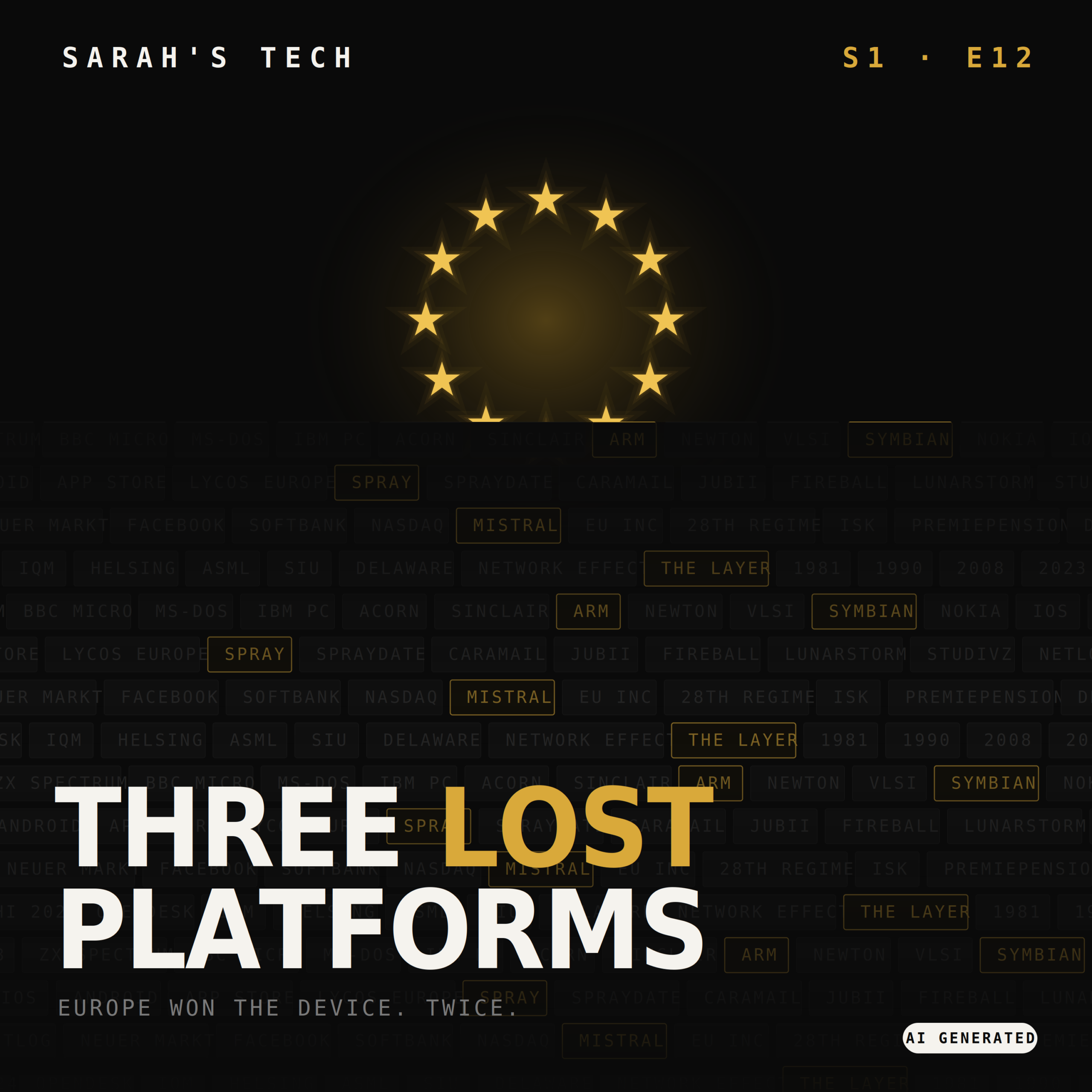
The pattern in one sentence: Europe won the device three times and lost the layer underneath three times — the standard, the network, the operating system. Round four is being assigned right now.
Loss One: The Standard (1981–2023)
In 1981 the BBC set out to find one official machine for its Computer Literacy Project. Two Cambridge companies competed: Sinclair Research, and Acorn Computers — founded by Chris Curry, who had worked for Clive Sinclair before leaving to start his own firm. Acorn won. The BBC Micro sold around 1.5 million units and taught a generation of British children to program.
Then the standard moved elsewhere. The IBM PC and Microsoft’s operating system became the platform everyone else built on and around, and within a few years the European home computer industry was gone: Sinclair sold to Amstrad in 1986, Acorn faded, Philips and Olivetti exited.
Meanwhile the BBC Micro’s profits had quietly funded an in-house chip project. Sophie Wilson designed the instruction set, Steve Furber the hardware; first working silicon came in 1985. In 1990 it was spun out as a joint venture between Acorn, VLSI Technology and Apple, which needed a low-power processor for the Newton. The name: Acorn RISC Machine. Later, Advanced RISC Machines. Today, Arm.
What happened to it since:
| Year | Event |
|---|---|
| 1998 | IPO in London and on Nasdaq |
| 2016 | SoftBank acquires Arm for about $32bn (£24.3bn) |
| 2020–2022 | Nvidia’s ~$40bn acquisition attempt collapses under regulatory pressure |
| 2023 | UK government campaigns for a London listing; Arm declines |
| Sept 2023 | IPO on Nasdaq at $51/share, ~$54.5bn valuation, ~$4.87bn raised; SoftBank retains ~90% |
| 2026 | Market value around $280bn — Europe’s second most valuable tech company |
The mechanism. Europe didn’t lose the customer. British children loved those machines. It lost the standard — the layer everyone else has to build on. Once that’s gone, the best available outcome is to be a brilliant supplier to someone else’s platform. Arm is exactly that: its designs are in roughly 99% of smartphones, and not one of those is a European platform.
The irony. Apple co-founded Arm in 1990. Apple silicon runs on Arm architecture today, and the returns flow to Cupertino and Tokyo.
Loss Two: The Network (1997–2008)
Disclosure: I worked at Lycos Europe during this period. The figures below are from public sources, not from anything internal.
Lycos Europe was founded in 1997 as a joint venture between Bertelsmann and Lycos Inc. In March 2000 it went public on Frankfurt’s Neuer Markt, raising about €612 million at a valuation near €5.5 billion.
Worth pausing on that exchange for a moment: for roughly six years, Germany had a functioning growth market with hundreds of tech listings and enthusiastic retail investors. Anyone claiming Germans are congenitally afraid of equities should explain the year 2000.
Then the shopping: Lycos Europe acquired Sweden’s Spray Network for roughly $570 million in cash and shares — including the Spraydate community and France’s Caramail — alongside Jubii in Denmark, Fireball in Germany, MultiMania in France and the Pangora shopping engine. This was European consumer internet, bought with European capital, run from Europe.
It wasn’t acquired by an American company. It dissolved. Spray went back to a Swedish publisher in 2006; on 26 November 2008 Lycos Europe announced it would wind down and sell what remained.
And it wasn’t alone in the landscape. Europe had LunarStorm in Sweden — among the world’s first social networks — plus StudiVZ in Germany, Netlog in Belgium and Skyrock in France. All of it is gone.
The mechanism. A portal is not a network. Lycos Europe bought reach: visitors, page views, mail accounts. Reach is rented attention — it walks out the door whenever something better appears. A network owns the connections between users: every added friend made leaving harder and joining more valuable for the next person. Hundreds of millions went into the thing that doesn’t compound while a dorm room built the thing that does.
Loss Three: The Operating System (1998–2013)
Nokia at its peak sold roughly four in ten mobile phones worldwide — the strongest consumer technology brand Europe has produced. The iPhone arrived in 2007, Android in 2008.
The part usually skipped: Nokia’s hardware remained excellent for years. What collapsed was Symbian, against two platforms with app stores. Developers followed users, users followed apps, and that loop compounded away from Espoo. By 2013 the phone business went to Microsoft. Nokia survives today as a network equipment supplier — a supplier again.
The Diagnosis That Doesn’t Hold
The intuitive explanation is that Europeans are somehow technology-averse. The adoption data says otherwise: European consumers embraced home computers, Nokia phones, social networks, streaming and contactless payments — often ahead of the US. What is larger in Europe is distrust of the institutions behind the technology, not of the devices themselves.
The stronger explanation is fragmentation. An American consumer startup gets 330 million people, one language and one legal system on day one. A European one gets 24 languages and 27 rulebooks. B2B tolerates that — English contracts, few large customers, long sales cycles. Consumer platforms live on cheap, fast scaling, which is exactly where fragmentation bites hardest.
But Sweden breaks it. Ten million people, an equity culture, high founder density — Spray, LunarStorm, Skype, King, Spotify, Klarna. If fragmentation were the whole answer, Sweden shouldn’t exist. And yet Spotify and Klarna both listed in New York. Neither theory survives contact with Stockholm. Which is where the levers come in.
Round Four Is Running Now
Same structure, new layer. Europe is again excellent below the platform: ASML makes the lithography machines, Schneider Electric powers the data centres, IQM builds quantum processors. The AI platform layer — models, assistants, the interfaces everyone will build on — is being set elsewhere. Europe’s most serious attempt is Mistral in Paris, which is private; the only public-market route into it runs through ASML’s €1.7bn stake.
The counter-move is institutional rather than entrepreneurial so far: openDesk, the Sovereign Tech Agency, public-code procurement — Europe’s first organised attempt to hold a layer instead of building devices. Whether that’s enough is an open question. (We covered it in Episode 10.)
Three Levers
1. Capital depth
Companies list where retirement savings sit in equities. That’s the unglamorous core. Europe’s savings are enormous and largely parked in bank deposits.
The proof that this is fixable is inside Europe: Sweden’s ISK investment account and its premium pension pushed ordinary savers into equities, and Stockholm has seen more IPOs over the past decade than Frankfurt and Paris combined.
Two levers travel with it. Dual-class shares, because founders who would lose control by listing at home list elsewhere instead. And index gravity, because passive money follows the indices that follow depth.
Resolving the Sweden paradox: national capital culture is necessary and not sufficient. A very good lake is still not an ocean — Klarna’s IPO needed more depth than any single European market offers. Which is why the answer is one European pool, not 27 national fixes, and why the Savings and Investments Union matters however bureaucratic it sounds. In June 2026 member states agreed a position on reforming the pan-European pension product; the Commission is pushing tax-favoured investment accounts — essentially the Swedish account, exported.
2. Staying power
Employee equity. Germany taxed stock options at grant for years — tax due on paper wealth before a single share could be sold. Dry income. Largely fixed in 2024: taxation is now deferred, up to fifteen years or until sale. Real progress, still patchwork — every member state does it differently, and virtual options, the workaround most startups use, are taxed as salary at rates up to 45%.
The legal shell. Klarna became a UK plc; Wise’s holding sits in Jersey. Not patriotism, convenience: no European form was as familiar to global investors. In March 2026 the Commission proposed the EU Inc. — a 28th regime, one European company form alongside the 27 national ones, with digital registration, EU-wide validity, and a single tax treatment for employee stock. Political agreement is targeted for end-2026; realistically the first EU Inc. gets incorporated around 2028.
Anchor customers. The least romantic and probably most effective lever: a company stays where its revenue lives. Public procurement — openDesk, standardised open-source contracts, the state as first big customer — creates a revenue base nobody walks away from. Patriotism doesn’t retain companies. Purchase orders do.
3. Open boards
The honest answer begins with a renunciation: Europe will not get its Google by building a more privacy-friendly Google. Rebuilding a platform that already won means burning capital against network effects that have already compounded.
Platform battles are winnable only while the board is still open. That’s the actual lesson of all three stories — Acorn lost a board IBM had already set; Facebook won one that was still empty.
Boards that are open right now:
- Industrial AI — the layer where factories meet models doesn’t exist yet, and Europe owns the factories.
- Defence technology — being assigned now, and for sovereignty reasons not easily American-owned. Helsing’s ~$18bn valuation reflects exactly that.
- Energy systems — grid, storage and demand orchestration as software.
- Quantum — IQM sells machines; the software layer above them is unclaimed.
The precondition for all of them is scale at home: a company form, a capital pool and procurement rules that make 450 million customers behave like one market instead of 27. Since the Draghi report in 2024 that agenda has moved from speeches into legislative machinery.
The Deadline
Round four doesn’t wait for the trilogue calendar. The AI platform layer is being assigned now — and on current form, by companies listed on Nasdaq.
The encouraging part, if you want one: this layer isn’t set in a keynote. It’s set in a million procurement and architecture decisions. Every agency choosing between a US model API and open weights, every hoster deciding whose inference to resell, casts a small vote on where it settles.
Question back to you: which of the three levers would change your business first — the capital, the company form, or the anchor customer? And if you were there for one of the three lost platforms: what did it look like from the inside? feedback@experten-system.de
Further Reading
Primary sources where they exist, and the best archives where they don’t. The episode keeps numbers deliberately thin; this is where to check them.
Loss one — Acorn, the BBC Micro and Arm
- BBC Computer Literacy Project Archive — the BBC’s own archive: 146 original programmes plus 121 related ones, broken into searchable clips. The history section covers how Acorn won the contract with the Proton prototype, and notes that the Acorn team went on to develop the RISC chips now in mobile phones.
- The BBC Computer Literacy Project — Archives of IT — a compact account of how the project led to the BBC awarding Acorn the contract, and of Sophie Wilson’s role in BBC BASIC.
- Chris’s Acorns at the Centre for Computing History — hardware documentation and original 1981 project material, hosted as part of the Chris Whytehead collection.
- Arm Holdings Form F-1 (SEC, 2023) — the IPO prospectus itself, including the corporate reorganisation into Arm Holdings plc. Long, but the risk factors section is the most candid document about Arm’s dependencies you will find.
- Arm’s own announcement of the F-1 filing — 21 August 2023, confirming the application to list on Nasdaq under the ticker ARM.
Loss two — Lycos Europe, Spray and the Neuer Markt
No canonical archive exists for this one, which is part of the point: a company that dissolved leaves fewer traces than a company that was bought. The March 2000 Neuer Markt prospectus, the Spray Network acquisition announcement and the 26 November 2008 wind-down statement are best found through newspaper archives and company-register records rather than a single web page. If you have a primary document from that period, send it — it belongs in this list.
Loss three — Nokia and Symbian
Covered exhaustively in business-school literature; start with Nokia’s own annual reports from 2007 to 2013 for the gap between hardware quality and platform share.
The levers
- EU Inc. — European Commission announcement, 18 March 2026 — the 28th regime: incorporation within 48 hours, under €100, no minimum share capital, with the Commission calling on Parliament and Council to agree by the end of 2026.
- The proposal itself (PDF) — COM(2026) 321 final, for anyone who wants the legal text rather than the summary.
- the28thregime.eu — an independent tracker of the legislative file, useful because this is a moving target: the Parliament’s JURI draft report of 29 June 2026 alone runs to 151 pages and 246 amendments.
- Savings and Investments Union — European Commission — the strategy adopted on 19 March 2025 to channel European savings into productive investment. A mid-term review is due in Q2 2027.
- The Draghi report on EU competitiveness — published 9 September 2024, the document that moved this agenda from speeches into legislative machinery. Part A is 65 pages; Part B is the 328-page analysis.
The counter-move, from Episode 10
- Sovereign Tech Agency — public investment in the open digital infrastructure everything else runs on.
- openDesk — the open source workplace for the public sector, and the clearest working example of the state as anchor customer.
Links checked August 2026. The EU Inc. and Savings and Investments Union files are live legislative processes — verify the current status before quoting either.
Sources: figures on Arm’s ownership and listings from company and press reporting; Lycos Europe IPO, acquisition and wind-down figures from contemporaneous reporting; EU Inc. and Savings and Investments Union status as of mid-2026 — both are ongoing legislative processes, so check for newer developments before quoting them.
Kommentar verfassen