Where It Will Land, and Why Europe Isn’t Last
Everyone purchased the technology. Almost nobody can demonstrate the financial return.
Across enterprise surveys, ninety-seven percent of executives claim to have deployed AI agents over the past year, with frontrunners managing multi-agent setups per knowledge worker. Yet fewer than a third report measurable returns from generative AI, under a quarter see payoff from autonomous agents, and seventy-three percent of CEOs cite operational stress from navigating the rollout. In Episode 15 of „Sarah’s Tech“, Sarah and I examine this widening split: is this systemic technology failure, or are we simply watching an economic rerun from the 1980s?
The Rerun: Robert Solow and the Productivity J-Curve
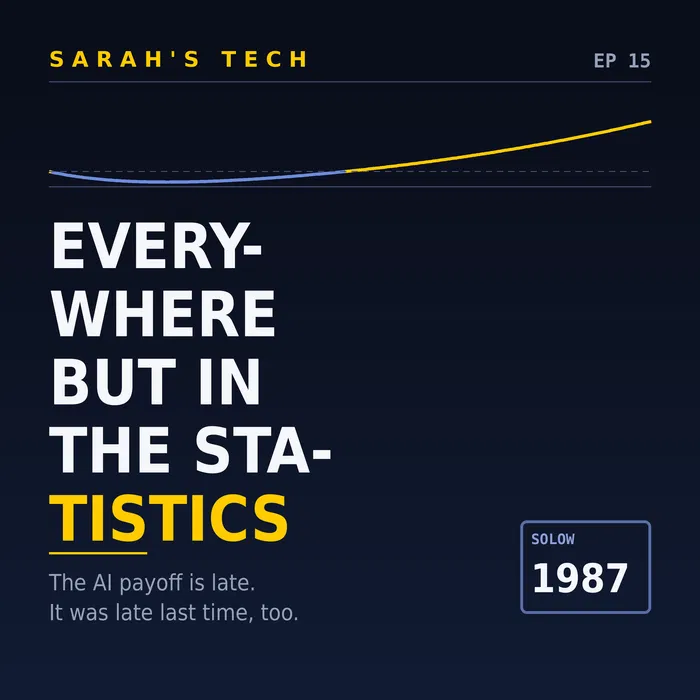
In July 1987, Nobel laureate Robert Solow summarized computing’s adoption lag in a single sentence: „You can see the computer age everywhere but in the productivity statistics.“
Corporate procurement teams spent a decade buying beige microcomputers while macro productivity numbers stayed completely flat. The measurable financial payoff arrived in the mid-1990s—roughly a decade late. The underlying mechanism is straightforward: buying hardware is the inexpensive, visible part. Redesigning organizational processes, retraining the workforce, and restructuring messy internal datasets represent the costly, invisible investments that weigh on margins for years.
Economists refer to this dynamic as the productivity J-curve. Initial capital expenditure books immediately as overhead with zero initial return, dragging down net performance before output eventually inflects upward. Seen through this lens, the sluggish enterprise ROI figures in 2026 reflect the trough of the J-curve rather than an outright dead end. For European organizations, methodical data remediation may not represent a structural delay—it could simply be the foundational half of the curve.
The Minitel Trap and the Modern „Dialer Moment“
Before the open internet arrived in European households, robust regional telematics networks already thrived: Prestel in the UK, BTX and Datex-J in Germany, and Minitel in France. Millions of French households used Minitel terminals for train timetables, banking, and messaging throughout the 1980s. Minitel’s legacy was not technical failure; it succeeded so thoroughly that abandoning it for the open web proved difficult. Whoever owns a functional, closed system transitions last.
The consumer internet ultimately broke through in markets like Germany not via revolutionary new infrastructure, but through distribution: 1&1 repurposed dialer software originally engineered for the BTX environment and distributed it on millions of magazine-mounted CDs. The future arrived through the old system’s distribution plumbing.
The AI sector faces a similar distribution bottleneck. Enterprise pilots remain heavily gated behind expensive consulting engagements. We put that distribution question to the test by reviewing eustella, a Viennese agent platform running open-weight models hosted on regional IONOS server clusters in Berlin and Frankfurt. While operational latency remains noticeable compared to centralized hyperscaler APIs, open-weight architectures provide an essential strategic guarantee: downloaded weight files cannot be revoked or turned off across borders.
What Empirical Stopwatch Trials Actually Reveal
Rigorous randomized controlled trials (RCTs) present a nuanced picture of workplace productivity:
- Customer Operations: Large-scale trials involving over 5,000 support professionals recorded an average 14 percent increase in successfully resolved tickets per hour.
- Software Engineering: Field experiments spanning thousands of developers at Microsoft, Accenture, and a Fortune 100 enterprise measured approximately 26 percent more completed tasks.
- The Leveling Effect: Across multiple controlled studies, below-average performers and novices saw output surge by 30 to 40 percent, whereas top performers recorded minimal uplift or occasionally slowed down.
AI functions primarily as a leveler, not an elite performance multiplier. It elevates the operational floor while the ceiling remains stationary—meaning individual competitive advantages can rapidly compete away. Furthermore, testing reveals a severe jagged technological frontier: where tasks cross beyond model capabilities, error rates spike dramatically, often without clear visual warning to the user.
Where the Margin Lands for Small Enterprises
While large corporations face margin compression as baseline cost savings are competed away, smaller and mid-sized operators can use low-overhead automation to remove minimum-scale barriers. Five practical playbooks stand out:
- The Long-Tail Task Backlog: Handling low-margin operational jobs where fixed administrative overhead previously rendered fulfillment unprofitable.
- Vertical Micro-Software: Deep domain tooling tailored to specialized trades where the competitive moat is workflow knowledge rather than code complexity.
- Succession Arbitrage: Acquiring succession-distressed small businesses trading at three to four times earnings, clearing operational backlog via agentic workflows instead of expanding headcount.
- Proprietary Domain Data: Leveraging historical bidding records, project estimates, and proprietary win/loss ratios that frontier foundation models have never indexed.
- Capacity Relief in Physical Trades: Automating back-office logistics to deploy scarce human technicians directly into high-value field work.
Evaluating State Initiatives: The Airbus vs. Gaia-X Framework
State-backed tech programs frequently draw immediate skepticism, but Europe’s industrial track record is nuanced. Evaluating initiatives like the €30 billion EuroHPC AI Gigafactories requires asking four baseline questions:
- Artifact vs. Framework: Does the initiative manufacture a tangible product (Airbus) or convene working committees (Gaia-X)?
- Committed Anchor Demand: Is volume secured upfront through guaranteed institutional buyers?
- Ecosystem Alignment: Does the contributor roster include competing foreign vendors whose core commercial interest lies in slowing local autonomy?
- Hardware vs. Horizon Bet: Concrete facilities carry thirty-year lifespans, while underlying compute accelerators turn obsolete in five.
Episode 15 Audio & Full Transcript
You can also subscribe and stream this episode directly on Apple Podcasts, Spotify, and via our direct RSS feed.
Sources & Empirical Research
Stopwatch Studies & Workplace Trials
- Brynjolfsson, Li & Raymond: Generative AI at Work (NBER Working Paper 31161) –
https://www.nber.org/papers/w31161
- Cui, Demirer, Jaffe, Musolff, Peng & Salz: The Effects of Generative AI on High-Skilled Work: Evidence from Three Field Experiments with Software Developers –
https://papers.ssrn.com/sol3/papers.cfm?abstract_id=4945566
- METR: Measuring the Impact of Early-2025 AI on Experienced Open-Source Developers –
https://arxiv.org/pdf/2507.09089
- Dell’Acqua, McFowland, Mollick et al.: Navigating the Jagged Technological Frontier: Field Experimental Evidence on the Performance Effects of Generative AI –
https://papers.ssrn.com/sol3/papers.cfm?abstract_id=4573321
Economic Frameworks & Market Adoption
- Brynjolfsson, Rock & Syverson: The Productivity J-Curve: How Intangibles Complement General Purpose Technologies (NBER Working Paper 25148) –
https://www.nber.org/papers/w25148
- Daron Acemoglu: The Simple Macroeconomics of AI (NBER Working Paper 32487) –
https://www.nber.org/papers/w32487
- Stanford HAI: Artificial Intelligence Index Report 2026 –
https://hai.stanford.edu/ai-index/2026-ai-index-report
- Bitkom e.V. (March 2026): Digitalisierung der Wirtschaft: Einsatz von Künstlicher Intelligenz in deutschen Unternehmen –
https://www.bitkom.org/Presse/Presseinformation/Digitalisierung-der-Wirtschaft-Unternehmen-beschaeftigen-sich-mit-KI
European Infrastructure & Projects
- Trending Topics: eustella startet Europas erste vollständig souveräne KI-Agenten-Plattform –
https://www.trendingtopics.eu/eustella-startet-europas-erste-vollstaendig-souveraene-ki-agenten-plattform/
- mrak.at: eustella und die Frage, was an europäischer KI wirklich souverän ist –
https://www.mrak.at/eustella-und-die-frage-was-an-europaischer-ki-wirklich-souveran-ist/
- Digital Chiefs: Digitale Souveränität 2026: Delos Cloud, Gaia-X und der EU Data Act –
https://www.digital-chiefs.de/digitale-souveraenitaet-2026-delos-cloud-gaia-x-eu-data-act-cios/
Disclosure: Sarah Vejlby is a synthetic co-host. Her voice is AI-generated and disclosed in every episode in compliance with the EU AI Act’s Article 50 transparency requirements. Markus works in the web hosting sector (goneo Internet GmbH). This website uses no tracking pixels.
Feedback: If you operate an SME or manage engineering workflows: which of the five doors have you opened, and have measurable margins materialized on your balance sheet? Share your figures and operational setups with us at: feedback@experten-system.de.

Kommentar verfassen