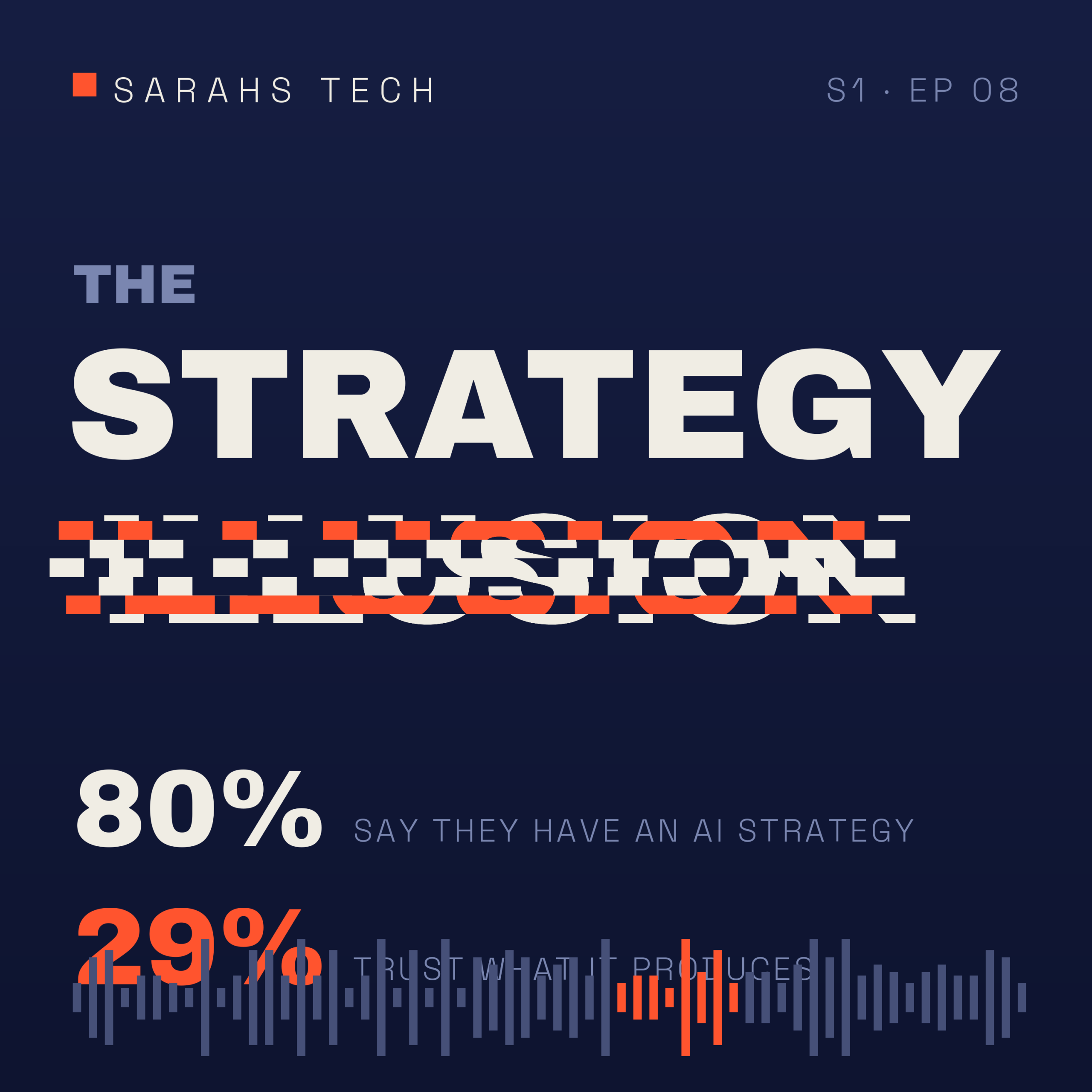
The Strategy Illusion

Sarahs Tech Podcast Cover 08 Season 1 2026 Strategy Illusion Sarahs Tech — a show hosted by someone who doesn't exist, with facts that very much do.

What Bosses Believe, What Builders Know (Sarah’s Tech S1·E08)

80% of European industrial companies say they have an AI strategy. The developers who build the actual products trust AI output at 29%. Someone here is wrong — or, more uncomfortably, nobody is.

The new episode of Sarahs Tech is out, and it lives in the gap between those two numbers.

What this episode is about

We start with a bet. Before the jingle, Markus claims AI makes him about twenty percent faster. Would he put money on that? He shouldn’t. A research lab recently put a stopwatch on experienced developers working on real tasks — randomized, screens recorded, time measured. With AI, they were 19% slower. And afterwards, they estimated they had been 20% faster. That forty-point gap between feeling and reality is the theme of the whole episode.

From there, we take the elevator through European tech, floor by floor:

The status report from the wall. The EU AI Act’s transparency rules go live on August 2nd — and no, the „delay“ you read about doesn’t apply to you. The high-risk rules were pushed to 2027 and 2028; the labeling duties arrive on time. There are official EU icons now („AI GENERATED“ / „AI MODIFIED“), the label belongs inside the content rather than the caption, and unlike NIS2, anyone with a smartphone can spot a violation. We walk through what that means for marketing teams, agencies, publishers and podcasters — including one detail that surprised us: AI translation counts as content that needs marking.

The view from the top floor. A fresh survey asked 800 industrial decision-makers across eight European countries about digital strategy. The results look great. Suspiciously great: 88% have a digitalization strategy, 80% an AI strategy, 92% plan new digital business models within three years. We do the source criticism this study deserves — and then dig out the three findings that are genuinely revealing. Data sovereignty ranks only third among infrastructure priorities, behind security and cost. Only half of decision-makers see Europe as one unified market — and the country that believes in it most is Germany, while France believes in it least. Germany dreams the European dream. Alone.

The view from the workbench. The people actually building the products tell a different story. Developer adoption of AI tools is basically done (84%), but trust in the output collapsed to 29% — and the most experienced developers are the most skeptical. Two thirds name the same frustration: solutions that are almost right, but not quite. Meanwhile, DACH freelancers have quietly turned pragmatic: more than half use AI daily, 18% already report lower hourly rates because of it, and 44% don’t tell their clients at all. That silence gets expensive after August 2nd.

We close with a practical four-step checklist to get ready for the deadline — inventory, review workflow, labels, contracts — plus one piece of advice for freelancers that has survived every technology Markus has worked with since 2000: say it before they ask.

One more thing

We open this episode with a confession. Sarah — the host this show is named after — doesn’t exist. Her voice is synthetic, her personality is a writing device, and everything she says is researched, written and editorially owned by Markus. From August 2nd, that disclosure becomes a legal requirement. We’re just early. Full concept behind Sarah: markus.technology/sarah

Listen now

🎧 Listen to the episode on your favorite podcast app or directly here:
The Strategy Illusion | What Bosses Believe, What Builders Know Sarah's Tech

Episode 8: The Strategy Illusion | What Bosses Believe, What Builders Know European industry reports near-total strategic readiness for AI. The people who build the software trust its output less every year. And when researchers put a stopwatch on experienced developers, the measurement contradicted the feeling. Sarah and Markus trace the gap between strategy and execution — from Brussels' final sprint toward the August 2nd transparency rules to the workbench reality of developers and freelancers across the DACH region. In this episode: 00:00–01:10: Cold Talk. How much faster does AI make you? Would you bet money on that? Markus commits to a number he will regret. 01:10–03:30: Cold Open & Full Transparency. The host of this show does not exist — and from August 2nd, saying so becomes a legal requirement under Article 50 of the EU AI Act. Sarah's Tech applies the rules to itself first. 03:30–10:00: Status Report from the Wall. The Commission's draft guidelines on Article 50, the Code of Practice with official EU labels ("AI GENERATED" / "AI MODIFIED"), why the omnibus delay covers legacy systems only, enforcement by anyone with a smartphone, the Bundesnetzagentur mandate — and the surprise that AI translation counts as content requiring marking. 10:00–17:00: The View from the Top Floor. The FACIS survey of 800 industrial decision-makers: 88% digitalization strategies, 80% AI strategies, 92% planning new digital business models — plus proper source criticism. The three findings that matter: sovereignty ranks third behind security and cost, only Germany believes in the unified European market (66% vs. France's 45%), and real ecosystem orchestration sits at one to twelve percent. 17:00–24:00: The View from the Workbench. Stack Overflow's 49,000-developer survey: 84% adoption, trust in output accuracy down to 29%, seniors most skeptical, "almost right but not quite" as the top frustration. The METR stopwatch study: 19% slower with AI while feeling 20% faster. And the DACH freelancer reality: 53% daily AI use, 18% reporting lower rates, 44% staying silent toward clients. 24:00–27:00: What You Can Do With This. Benchmark yourself against the survey, then the August 2nd checklist: inventory your generating tools, document genuine human review, build the labels into your templates, and close the disclosure chain in your contracts. Rule five: say it before they ask. 27:00–28:30: Verdict & Outro. Companies that measure the feeling will write great slides. Companies that measure the output will win. Key Takeaways: The Delay That Isn't: The Digital Omnibus pushed high-risk AI obligations to 2027/2028, but the Article 50 transparency duties arrive on schedule — the December 2nd grace period covers only the machine-readable marking of systems already on the market before August. Visible-by-Eye Enforcement: Unlike NIS2, an Article 50 violation can be spotted by any listener or viewer, making complaints and cease-and-desist waves the expected enforcement pattern, with fines up to fifteen million euros or three percent of global revenue. The Strategy–Execution Divide: The FACIS data shows the real split in European industry runs not between digital leaders and laggards, but between companies that have a strategy and companies that have an execution engine. The Perception Gap: The METR randomized trial documents a forty-point spread between how AI-assisted work feels and what the clock measures — explaining why top floors are euphoric while workbenches grow skeptical. Links & Resources: Regulatory Framework: EU Commission — AI Act Regulatory Framework, Article 50 Guidelines & Code of Practice on Transparency Implementation Timeline: EU AI Act — Full Text and Implementation Tracker Industry Survey: FACIS — Unlocking New Digital Business Models in Europe 2026 (n=800, May 2026) Developer Sentiment: Stack Overflow Developer Survey 2025 (n=49,000+) The Stopwatch Study: METR — Randomized Controlled Trial on AI and Experienced Developer Productivity DACH Freelancer Data: freelance.de — Freelancer-Studie 2026 (n=3,300) Market Context: freelancermap — Freelancer-Kompass 2026 (n=5,400) Transparency Concept: A Note on Sarah — Why This Show Discloses Its Synthetic Host Feedback: Are you the manager with the strategy slide, the developer with the trust problem, or the freelancer deciding whether to tell the client? Send your stories — anonymously if you prefer — to feedback@experten-system.de. The best ones make it into a future episode.

All sources — the FACIS survey, the Stack Overflow Developer Survey, the METR stopwatch study, the freelancer studies, the Article 50 guidelines and the Code of Practice with the icons — are linked in the show notes.

Are you the manager with the strategy, the developer with the trust problem, or the freelancer deciding whether to tell the client? Write to us — the best stories make it into a future episode, anonymously if you prefer.


Sarahs Tech — a show hosted by someone who doesn’t exist, with facts that very much do.

Kommentare

Kommentar verfassen